Here is an option to acquire the Manga Guide to Electricity through the public library:
https://catalog.aclib.us/search/searchresults.aspx?ctx=1.1033.0.0.6&type=Keyword&term=manga%20guide%20to%20electricity&by=KW&sort=RELEVANCE&limit=TOM=*&query=&page=0&searchid=1
You can get a library card at the downtown location and access it online:
401 E University Ave, Gainesville, FL 32601
Showing posts with label Aaron Williams. Show all posts
Showing posts with label Aaron Williams. Show all posts
Monday, August 29, 2016

Wednesday, August 24, 2016
How to Make a Blog Post
Hi everyone!
Welcome to the 2016 Sensors for Artists course and to the blog where you will share assignments, concepts, and notes. This blog is here to help with grading your assignments but also as your sounding board for anything relevant you would like to contribute to the site!
On that note, a quick how-to on posting to the blog with the proper tag to make everything easy!

Click the New Post link in the upper right hand corner.
From your Google Blogger home page, just click the name of our blog "Sensor-Based Electronic Art" and click the "New Post" button on the left-hand side of the page:
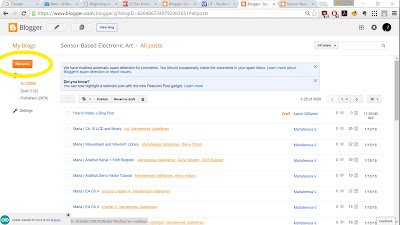
It's also very useful for everybody for you to tag your posts with the title of the assignment and with your name. You can do so by clicking "Labels" on the right-hand side of the post composition page and then typing out the tag you would like to include with your post. This allows you to see all of your posts by clicking your name tag from the blog home page.

Welcome to the 2016 Sensors for Artists course and to the blog where you will share assignments, concepts, and notes. This blog is here to help with grading your assignments but also as your sounding board for anything relevant you would like to contribute to the site!
On that note, a quick how-to on posting to the blog with the proper tag to make everything easy!
From the blog's web url: https://sensorbased.blogspot.com/

Click the New Post link in the upper right hand corner.
From your Google Blogger home page, just click the name of our blog "Sensor-Based Electronic Art" and click the "New Post" button on the left-hand side of the page:

It's also very useful for everybody for you to tag your posts with the title of the assignment and with your name. You can do so by clicking "Labels" on the right-hand side of the post composition page and then typing out the tag you would like to include with your post. This allows you to see all of your posts by clicking your name tag from the blog home page.

Thursday, December 17, 2015
Semester Project Process Videos
I 3D printed a great case for the Arduino but the Uno friend and I used the Leonardo (which was pretty anyway since I was doing keyboard commands).
Final Semester Project
As I had suspected, the "final" presentation of this work still felt very much in-progress. Most of my worktime was spent wrestling the circuit itself, working with Charlie, Jason Huang, and eventually Luis Cruz just to get a usable signal. For the time, this signal was simply not going to work REM eye movement -- the signal was too fast and small for this circuit which is why labs have the nice $3,000 amps, I suppose.
Working so long on getting a signal left me choked for time programming in the game engine to create an .exe to interface with the signal. The current build I had of the labyrinth just didn't really show much with the signal I had so I did a quick makeover to a simple object based programming that moved sprites left or right according to the signal.
For the presentation of the project I took a more performative approach. I hooked up James in the computer lab to the electrodes and gave him instructions to follow my finger with his eyes, shined a light in one eye at a time, etc. At this time the circuit did not work. There are many possible reasons, but the most prominent were the potential additional noise present in the electronics of the computer lab, James was actually sweating a little and that can have a big impact, or some other unforseen change between my testing at home and then running it in the lab. As a side note, the circuit works best with very strong eye movement in one direction or the other, and works the most clearly when you close one eye or the other. James was biologically unable to close his left eye without closing his right eye, so that didn't help either. It's okay James; maybe your children won't inherit that gene so I can experiment on them.
Running it as a performance, shoddy as it was in the setting and context of time, definitely gave me some great ideas on how to tweak it as I lock down the signal.
Overall, dissatisfied with the current state of the project as a work of art, but as a progression toward something greater I am very happy to have a lot of the groundwork laid out. With the elements I have it is just a matter of spending more time calibrating the circuit, adding filters, and working on the executable.
Here are some photos taken by Kelsey while I subject James to weirdness:


Attached to this post is the .exe
EOG.exe
Arduino Leonardo Code:
//read electrode signal on pin A0
int analogpin={A0};
int threshold=500;
void setup() {
// initialize serial communication at 9600 bits per second:
Serial.begin(9600);
//start keyboard library
Keyboard.begin();
}
void loop() {
// read the input on analog pin 0:
int sensorValue = analogRead(A0);
{
//If the electrode signal has a high voltage, the wearer is looking Right.
if (analogRead(analogpin)>threshold)
{
Serial.println("RIGHT");
Keyboard.write(0xD7);
}
//If the electrode signal has a low voltage, the wearer is looking Left.
if (analogRead(analogpin)<threshold)
{
Serial.println("LEFT");
Keyboard.write(0xD8);
}
//Otherwise play static animation; this will likely never really happen in this instance.
else
Serial.println("STATIC");
}
delay(500);
}
Working so long on getting a signal left me choked for time programming in the game engine to create an .exe to interface with the signal. The current build I had of the labyrinth just didn't really show much with the signal I had so I did a quick makeover to a simple object based programming that moved sprites left or right according to the signal.
For the presentation of the project I took a more performative approach. I hooked up James in the computer lab to the electrodes and gave him instructions to follow my finger with his eyes, shined a light in one eye at a time, etc. At this time the circuit did not work. There are many possible reasons, but the most prominent were the potential additional noise present in the electronics of the computer lab, James was actually sweating a little and that can have a big impact, or some other unforseen change between my testing at home and then running it in the lab. As a side note, the circuit works best with very strong eye movement in one direction or the other, and works the most clearly when you close one eye or the other. James was biologically unable to close his left eye without closing his right eye, so that didn't help either. It's okay James; maybe your children won't inherit that gene so I can experiment on them.
Running it as a performance, shoddy as it was in the setting and context of time, definitely gave me some great ideas on how to tweak it as I lock down the signal.
Overall, dissatisfied with the current state of the project as a work of art, but as a progression toward something greater I am very happy to have a lot of the groundwork laid out. With the elements I have it is just a matter of spending more time calibrating the circuit, adding filters, and working on the executable.
Here are some photos taken by Kelsey while I subject James to weirdness:


Attached to this post is the .exe
EOG.exe
Arduino Leonardo Code:
//read electrode signal on pin A0
int analogpin={A0};
int threshold=500;
void setup() {
// initialize serial communication at 9600 bits per second:
Serial.begin(9600);
//start keyboard library
Keyboard.begin();
}
void loop() {
// read the input on analog pin 0:
int sensorValue = analogRead(A0);
{
//If the electrode signal has a high voltage, the wearer is looking Right.
if (analogRead(analogpin)>threshold)
{
Serial.println("RIGHT");
Keyboard.write(0xD7);
}
//If the electrode signal has a low voltage, the wearer is looking Left.
if (analogRead(analogpin)<threshold)
{
Serial.println("LEFT");
Keyboard.write(0xD8);
}
//Otherwise play static animation; this will likely never really happen in this instance.
else
Serial.println("STATIC");
}
delay(500);
}
Tuesday, December 15, 2015
EOG Amplification Circuit Fritzing Diagram

Ultimately, the Notch and OpAmp circuits never worked correctly. For this semester I will be working with the EOG circuit amplified through the Instrumental Amp IC INA118P. This signal is a bit noisey but does still distinguish left eye movement from right eye movement.
This circuit is not sensitive enough to detect something as small as REM, but is a great starting point for exploring EOG Arduino interface because IT WORKS.
The power supply should be 12V 1A for the L7805s I am using, but the only adapter I have that works with the circuit correctly is 2A. Ideally, the L7805s would also be a different variation of the same regulator, LM7805. Theoretically there is no difference, but in reality I do get an output voltage of 8.6V when it is supposed to give me 5V from one regulator, and a 3.3V from the other. Something here isn't working correctly, but I've studied the circuit intensely and following the instructions for it soundly so my suspicion is either the 12V 2A adapter is effecting it, or the difference between LM7805 and L7805.
The L7805 circuit takes the 12V power supply and regulates it down to a smooth 5V. The reason we are using two supplies is to drive the differential amplification between the two electrode inputs. Thus a power supply ground is created from the 12V supply, and a second, virtual ground, is made from the output voltage of the second regulator.
The INA118P takes the signal input and amplifies it with a gain of +500 (giving us a net gain of +501 to the signal). We use a 100ohm resistor to set the gain. There is a chart on the INA118P's datasheet that shows how to set the gain with different resistors.
When we move our eyes the electrical signal from the skin polarizes the corresponding electrode and raises or lowers the voltage. A GND electrode is connected to the forehead and to the virtual ground of the 7805 series. This signal is output as a single voltage to the Arduino's Analog 0 input and the ATMEGA328P converts it into a digital value we can then use in programming (ADC).
Sunday, December 13, 2015
Semester Project Log
Circuit Iterations 1, 2, and 3 do not give desired results. Nothing useable attained.
Met with Jason Huang, Biomedical engineer undergraduate. He lended me an Analog Discovery device and I am using Waveform to view my signal with its oscilloscope function.
Documentation of components and voltage as I build the circuit once again from scratch, checking each component's voltage as I move along.
5th Attempt:
I feel I understand the circuit significantly better now, and as such I am attempting the 5th build from this schematic:
http://onloop.net/hairyplotter/images/final_eog_ckt.png
This schematic is more intended for Arduino Uno. I didn't understand this person's schematic at first so I avoided it but now it makes more sense to me having built the very similar one presented in the MAKE Magazine article.
Met with Jason Huang, Biomedical engineer undergraduate. He lended me an Analog Discovery device and I am using Waveform to view my signal with its oscilloscope function.
Documentation of components and voltage as I build the circuit once again from scratch, checking each component's voltage as I move along.
- 12 V wall-plug transformer to barrel plug power supply.
Transforms household 120v to 12v.
Multimeter is actually reading at 18.46v.
Barrel plug reads 18.46v.
Changed to a different "12v" 1A adapter aaaannnnd.....reading at 6.07v. This won't work either...goes to show checking your equipment with a multimeter is extremely valuable.
Luckily...had a third "12v" AC/DC transformer and finally 12(ish)v! - 7805 Voltage regulator (2)
Both regulators read out at 0.054v from 18.46v input.
After switching to the actual 12v adapter I get 0.23v which is a very significant difference. - All gold-cup electrodes have about 1.5ohm resistance from cup to terminal.
Left and Right electrodes tested positive for continuity to pins 2 and 3 to INA118.
Through Analog Discovery + Waveforms successfully got a signal but currently is too noisey -- which is the point of the filters. At this point I only have the 12v supply running through the regulators and into the INA118. I get a readout that fluctuates between just under +5v and a little bit over -5v which is pretty ideal from what I understand. - Found a bad resistor in the Notch Filter circuit. a 3.3k ohm resistor was reading at nearly nothing...0.03 ohm. Signal read on WaveForms from LM358 filter are low and inconsistent. Uncertain if this is "normal" before the LM741 IC integration.
- Signal unusable after LM741 integration. Reverting back to sampling the INA118 with the rest of the circuit built also yields significantly different results at before.
- Arduino Paul Uno is no longer responding to any serial input/output after swapping things around trying to get a sensible value. RIP Paul.
5th Attempt:
I feel I understand the circuit significantly better now, and as such I am attempting the 5th build from this schematic:
http://onloop.net/hairyplotter/images/final_eog_ckt.png
This schematic is more intended for Arduino Uno. I didn't understand this person's schematic at first so I avoided it but now it makes more sense to me having built the very similar one presented in the MAKE Magazine article.
- Power Supply to Regulators
12v DC power confirmed from power supply. 7805 regulators confirmed connected by the right gates,
7805 (a) 1 --- connected to 7805 (b) confirmed
7805 (a) 2 --- to Power Supply GND confirmed
7805 (a) 3 --- to 7805 (b) 2 (GND) confirmed
7805 (b) 1 --- connected to 7805 (a) confirmed
7805 (b) 2 --- to 7805(a) 3 confirmed
7805 (b) 3 --- V+ out to INA118 pin7 confirmed - INA118 InstrumentationAmp (+500 gain)
11.2v between pin4(GND) and pin7(V+ input)
pin1 to pin8 connected by 100ohm resistor (+500 gain)
pin7 V+ output to LM358 pin8 Notch Filter
pin6 passes through parallel cut-off circuit to filter out high frequencies; this parallel reconnects to pins 2 and 3 of LM358 as positive and negative voltages. - LM358
Filters noise from the amplified V+, V- signal and outputs it through pin6 toward the final amplification circuit LM741
Cut-off circuit connection test:
R2 connected to C1, C2, C3, and R3
R3 connected to C1, C2, C4, and R2
R4 connected C1, C2, C3, C4
pin2 of LM358 connected C1, C2, and R4
pin3 connected to R2, R3, C3, and C4
pin6 to resistor, capcitor(to GND), and onward to LM741 pin3 as V+ - LM741 final amplification IC
V+ signal from pin6 of LM358 with a difference of the virtual GND
Output voltage follows the input by connecting V- (pin2) to Vo giving the analog signal.
When I hook up the Arduino Analog 0 to pin 6 of 741 I get the same arbitrary drifting of values as before.
Received an e-mail from Luis Cruz himself this morning, giving me access to the Google Drive Eyeboard documents. After several more builds from this guide I came to a temporary solution. I bypassed the notch and opamp, getting the signal from the instrumental amp (118P) alone and I have a useable signal for the purposes of this project. It is still cluttered and takes a strong eye movement to detect but the values do indeed rise with right eye movement, drop with left eye movement, and stay relatively steady when stationary.
Monday, November 23, 2015
Getting Started in Electronics by Forrest Mims Notes
Getting Started in Electronics by Forrest Mims
Notes
Chapter 1 - Electricity
Ions - Atoms are normally balanced, but when an electron is removed from a balanced atom it becomes a positive ion, and conversely when a stray electron attaches to a balanced atom it will become negatively charged as a negative ion.
Electrons - Electrons can rest on a surface or travel nearly the speed of light. (186,000 mps). When electrons rest on a surface this surface an be said to have a negative static electrical charge. Electrical current is what we call electrons in motion. Resting electrons can be put into motion by positive ions as they attract the free electrons to balance the atom by filling the electron gaps.
Electrons are removed through friction, heat, light, and chemicals to create positive ions and a surface with resting positive ions has a positive static electrical charge.
"Electron" is named after the Greek word for "amber". Amber is easily electrified by friction.
Electrons can travel through moist air and leak away on a humid day.
Like charges repel, unlike charges attract.
Conductors - Materials through which electrons travel: silver, gold, iron, copper, etc.
Insulators - Materials through which electrons travel poorly or not at all: glass, plastic, rubber, wood
Direct Currents (DC) - current through a conductor that can only flow in one direction.
Notes
Chapter 1 - Electricity
Ions - Atoms are normally balanced, but when an electron is removed from a balanced atom it becomes a positive ion, and conversely when a stray electron attaches to a balanced atom it will become negatively charged as a negative ion.
Electrons - Electrons can rest on a surface or travel nearly the speed of light. (186,000 mps). When electrons rest on a surface this surface an be said to have a negative static electrical charge. Electrical current is what we call electrons in motion. Resting electrons can be put into motion by positive ions as they attract the free electrons to balance the atom by filling the electron gaps.
Electrons are removed through friction, heat, light, and chemicals to create positive ions and a surface with resting positive ions has a positive static electrical charge.
"Electron" is named after the Greek word for "amber". Amber is easily electrified by friction.
Electrons can travel through moist air and leak away on a humid day.
Like charges repel, unlike charges attract.
Conductors - Materials through which electrons travel: silver, gold, iron, copper, etc.
Insulators - Materials through which electrons travel poorly or not at all: glass, plastic, rubber, wood
Direct Currents (DC) - current through a conductor that can only flow in one direction.
- Current(I)- quantity of electrons passing a given point in units of amperes. One ampere = 6,280,000,000,000,000,000 (6.28 x 10 (to the 18th power))
- Voltage (V or E)- Electrical pressure or force. Sometimes referred to as potential. Voltage Drop is the difference between voltages at two ends of a conductor.
- Power or Watt (P) - Work performed by an electrical current. Power of DC = voltage x amps.
- Resistance (R) - Resist current in Ohms. Resistence of a conductor is its VD / I.
V= I x R
I = V / R
R = V / I
P = V x I (or) I(squared) x R
Page 15: Explain in 25 words how the straw/nail motor works:
The nail inside the straw is magnetized by the coil of wire connected to the battery. As the current flows it is "tugged" either way by the positive charge in its center.
Making DC Electricity:
- electrolytes - chemical DC generators. A solution that contains many ions may be broken down and conductors can utilize the positive ions and negative ions to create a current in a "wet cell". "Dry cells" would be that where an electrolyte is absorbed by paper or formed into a paste. The lemon battery.
- electromagnets - A moving magnet can generate a field of DC in the direction the magnet is pushing.
- thermoelectric generators - heating two dissimilar metals will create a difference in voltage between the two materials in what is called a seeback effect.
Alternative Currents (AC)
The direction or polarity of a current can be altered or reversed resulting in an alternating current.
transformer: A wire carrying AC will induce a current in a nearby wire. (used for long distance powerlines)
electrical circuit - allows current to flow.
electrical ground: protects from shock hazard by reducing voltage to 0.
Pulse - sudden, brief increase or decrease in a current flow.
Wave- A periodic fluctuation in a current or voltage.
Signal - Periodic waveform that conveys information. The process that generates the waveform is called modulation.
Noise - Small, random unwanted electrical currents in all electrical devices and circuits.
Chapter 2 - Electronic Components
The direction or polarity of a current can be altered or reversed resulting in an alternating current.
transformer: A wire carrying AC will induce a current in a nearby wire. (used for long distance powerlines)
electrical circuit - allows current to flow.
- A basic circuit has a power source and a load. A load can be a lamp, motor, etc.
- A series circuit may include more than one load and the current flows directly through one component to another.
- A parallel circuit is when multiple components are connected to a power source but do not have to flow from one component to another.
- A series parallel circuit includes both components wired in a series and in a parallel.
electrical ground: protects from shock hazard by reducing voltage to 0.
Pulse - sudden, brief increase or decrease in a current flow.
Wave- A periodic fluctuation in a current or voltage.
Signal - Periodic waveform that conveys information. The process that generates the waveform is called modulation.
Noise - Small, random unwanted electrical currents in all electrical devices and circuits.
Chapter 2 - Electronic Components
Sunday, November 22, 2015
Skycraft Alternative Project
Alternative to Skycraft
Scavenger Hunt 20 points
Please go on the internet
and find the following products. Please provide me with a URL Have
fun shopping!
Please locate 4 different
kinds of LEDs. Look up the voltage and amp specs for each. 2 points
- 10 Segment LED Bar Graph – Blue
https://www.sparkfun.com/products/9937
Volts:3.6V Amp:20ma
- RGB LED Chain - 20 LED Addressable
https://www.sparkfun.com/products/11020
Volts:5V Amps: 1.8A - Vollong 3W White High Power Linear COB LED
https://www.superbrightleds.com/moreinfo/high-powered/vollong-3w-high-power-linear-cob-led/1005/2426/#/tab/Specifications
Volts: 13.5V Amps:300mA - 30W White High Power Planar COB LED
https://www.superbrightleds.com/moreinfo/high-powered/30w-white-high-power-planar-cob-led/1255/
Volts:34V Amps:1500mA
Find two devices that
contain solar panels and tell me what they are. 1 point
Solar Power-Storing Sun Glasses
These sunglasses function in two ways: protecting the eyes from harmful rays while also collecting sunlight to power small devices.
http://www.yankodesign.com/2008/12/17/solar-powered-solar-panel-sun-glasses/
I-Slate
This tablet was developed as a low-cost option for schools without electricity to have access to an electronic notepad and self-teaching tools.
http://www.rice.edu/nationalmedia/news2010-11-08-islate.shtml
Find a breadboard. .5
point
https://www.adafruit.com/products/64
Go to Makers Shed or
American Scientific and find 5 devices that contain sensors and tell
me what they do. 2.5 for devices and .5 what they do 3 for total of 3
points
Particle Photon IoT Prototyping Breakout Board
Solderless board with headers, Broadcom BCM43362 Wi-Fi chip and Particle P0 Wi-Fi module useful for IoT prototyping.
http://www.makershed.com/products/particle-photon
Simon Says Through-Hole Soldering Kit
Package must be soldered. 4 LEDs with pushbuttons are soldered to the board and controlled through arduino to emulate Simon Says.
http://www.makershed.com/products/simon-says-through-hole-soldering-kit
Touch Board Starter Kit
Kit includes everything you need to turn any surface into a touch-interface.
http://www.makershed.com/products/touch-board-starter-kit
Ozobot
These little bots detect color and can be programmed to react through movement and LEDs.
http://www.makershed.com/products/ozobot-bit-dual-pack-set
Find 6 different kinds of
cables and give me specs of each size in gauge. Also look up what
each kind. 3 point total
6 AWG Jumper Cables
http://www.amazon.com/Tangle-Battery-Booster-cables-travel/dp/B008BWGBKC
10 AWG Copper Wire for Residential Wiring
http://www.homedepot.com/p/Southwire-100-ft-10-Gauge-3-Conductor-NM-B-Cable-Orange-63948426/202316240
16 AWG Universal Power Cord with 3-Pin Connector
http://www.amazon.com/SF-Cable-35ft-Universal-Power/dp/B005J5ZK3I
20 AWG Copper Wire for Automotive and General Electric Use
http://www.delcity.net/store/20-Gauge-Wire/p_181397
30AWG High Speed HDMI Video Cable
http://www.monoprice.com/product?p_id=6917
50 AWG Fiber Optic Wire
https://www.platt.com/platt-electric-supply/Fiber-Optic-Cables-Multimode/Hitachi-Cable-America-Inc/61468-6/product.aspx?zpid=102647
Locate a really cool
electronics kit that measures something. What does it do? .5 points
Botanicals Kit
This kit comes with everything you need to give your plant access to online capabilities allowing it to do things like post to Twitter when it is in need of water or love.
https://www.sparkfun.com/products/10334
Find 5 different motors
and describe each look up what they might be used for. Please tell me
if they are DC motors, servo motors, AC/DC motors or stepper motors.
3 including descriptions
1. AC/DC "Diorama" Animation Motor
Small motors to use in dioramas to power tiny railroads, carousels, etc.
http://www.micromark.com/animation-gearmotor,7886.html
2. 8 Wire NEMA 34 Step Motor
Programmable motor that can move a number of degrees at a programmed speed.
http://www.circuitspecialists.com/step-motor-nema-34-85bygh450c-03.html
3. Continuous Rotation Servo Motor
Robot servo with full circle motion.
http://www.robotshop.com/en/hitec-hsr-1425cr-continuous-rotation-servo.html
4. High Torque Industrial Servo Motor
Servo with strong torque for industrial applications.
http://www.robotshop.com/en/torxis-i01857-12v-high-torque-industrial-servo-motor.html
5. DC Toy Hobby Motor
Small 4.5-9V motor for small electronics projects.
https://www.adafruit.com/products/711
Small motors to use in dioramas to power tiny railroads, carousels, etc.
http://www.micromark.com/animation-gearmotor,7886.html
2. 8 Wire NEMA 34 Step Motor
Programmable motor that can move a number of degrees at a programmed speed.
http://www.circuitspecialists.com/step-motor-nema-34-85bygh450c-03.html
3. Continuous Rotation Servo Motor
Robot servo with full circle motion.
http://www.robotshop.com/en/hitec-hsr-1425cr-continuous-rotation-servo.html
4. High Torque Industrial Servo Motor
Servo with strong torque for industrial applications.
http://www.robotshop.com/en/torxis-i01857-12v-high-torque-industrial-servo-motor.html
5. DC Toy Hobby Motor
Small 4.5-9V motor for small electronics projects.
https://www.adafruit.com/products/711
Find 3 types of camera or
optical devices. 1.5 points
Optical Detector Photoresistor
https://www.sparkfun.com/products/246
Optical Dust Sensor
https://www.sparkfun.com/products/9689
LinkSprite JPEG Color Camera TTL Interface - Infrared
https://www.sparkfun.com/products/11610
Find three devices that
deliberately (sound production is part of their function) produce
sound and tell me what they are. 1.5
Spark Punk Sound Kit
The Spark Punk is a synthesizer redesign of the Atari Punk. It has several different knobs and switches for creating unique sound banks and controlling tones.
https://www.sparkfun.com/products/11177
Wonder Beeps
This kit comes with everything you need to set up a wireless control device that turns the power state to HIGH or LOW triggered by an embedded sound.
https://www.sparkfun.com/products/11560
Sparkfun Metro-Gnome
A simple digital metronome kit that emits a click to keep time with music at a set BPM.
https://www.sparkfun.com/products/9236
Find five different kinds
of potentiometers or variable resistors. What is their range of
voltages? What are they used for? 3
SoftPot Membrane Potentiometer
A variable resistor strip with a resistance range of 100Ohms to 10,000Ohms depending on where the strip is being pressed. A practical application would be for an accurate positional input such as a CNC router.
https://www.sparkfun.com/products/8680
Knob Cubelet
Knob potentiometer embedded into magnetic cubes that output 0 at one end and 1 at the other. These cubes are basically magnetic components that "program" different behaviors through their magnetic connections.
https://www.sparkfun.com/products/11935
Slide Pot - Motorized
A motorized slide pot that uses a small belt-driven motor with two separate 10k audio taper potentiometers.
https://www.sparkfun.com/products/10734
Soil Moisture Sensor
3.5-5V variable resistor that measures moisture in soil through a breakout board with two conductive resistors. The more moisture on the two surfaces the more conductivity and lower resistance.
https://www.sparkfun.com/products/13322
Force Sensitive Resistor - Square
The square has a resistance of 1 megohm+ when no force is being applied, but when pressure is enforced the resistance is lowered allowing a higher voltage to pass through.
https://www.sparkfun.com/products/9376
Find three different kinds
of project boxes to house an electronics project. 1.5 points
Aluminum Enclosure
http://www.alibaba.com/product-detail/168-54-100-w-h-l_906945441.html?spm=a2700.7724857.29.37.hUvduP&s=p
Weatherproof Case with Clear Top
http://www.mcmelectronics.com/product/ADAFRUIT-INDUSTRIES-905-/21-14635
Black Mini Plastic Box
http://www.mcmelectronics.com/product/HAMMOND-1551GBK-/21-9862
Find an LCD panel. .5
points
Microtips 4.3" Diagonal LCD panel
http://www.mouser.com/ProductDetail/Microtips-Technology/UMSH-8253MD-1T/?qs=sGAEpiMZZMt7dcPGmvnkBkT869FPfqkbXrUbQKnlyfw%3d
I
want to build a special holiday hat that lights up when I tilt my
head side, plays music when I tilt my head backwards and shoots off
my head when I tilt my head forward. Please make a list of the
supplies with URLS that I will need to build this hat. (3 points)
Lilypad:
https://www.sparkfun.com/products/10274
Conductive Thread:
https://www.sparkfun.com/products/11791
Accelerometer:
https://www.sparkfun.com/products/9269
Wave Shield:
https://www.adafruit.com/products/94
LEDs Assort pack:
https://www.sparkfun.com/products/12062
Shotgun for when the hat "shoots off my head when I tilt my head forward":
http://www.cheaperthandirt.com/product/7-G982
Total Points
Wednesday, November 18, 2015
Mini Project #2 - Dreammachine v2.0 Documentation
Kelsey was kind enough to subject herself to my dream machine today. Not everyone felt so brave. Madaline took photos and video because she is on it. Thanks Madaline.


I will check out a HD camera soon and document a video for my portfolio. I will share this with the blog once I have done so.
Mini Project 2 - Process
Enterface: Dreammachine v2.0 is a cover of Brion Gysin and William S. Burrough's DreamMachine. The interface device is designed to control light pulses in sync with alpha brain waves to create hallucinations. A thermoresistor controls the pulses from a range of 8pps to 13pps. The cooling face gel mask and neck pillow relaxes the 'viewer' as they enjoy the show. The slowing of breath often increases the temperature and keeps it steady.

Not exactly rocket science. Thankfully we're making art, not rockets. To all you having trouble this is how simple your circuit can be, but think more critically on how to apply it. Ya'll are having so many issues with this portion so maybe simplify the circuitry and home in on your interfaces.
My coding was simple and custom-built using IF/THEN statements and set variables that turn off the pulsing with ambient room temperature. I used Gysin's maths for my maths. The cylinder is essentially circuitized.
//TMP36 Pin Variables
const int POT=0; //Pot on analog pin 0
int val = 0;
const int LED=9; //define LED for Pin 9
const int EIGHT=150;
const int NINE=154;
const int TEN=158;
const int ELEVEN=161;
const int TWELVE=164;
const int THIRTEEN=168;
void setup()
{
Serial.begin(9600); //Start the serial connection with the computer
//to view the result open the serial monitor
pinMode (LED, OUTPUT);
}
void loop() // run over and over again
{
val = analogRead(POT);
Serial.println(val);
if (val > EIGHT)
{
digitalWrite(LED, HIGH);
delay(63);
digitalWrite(LED, LOW);
delay(263);
}
else if (val > NINE)
{
digitalWrite(LED, HIGH);
delay(56);
digitalWrite(LED, LOW);
delay(156);
}
else if (val > TEN)
{
digitalWrite(LED, HIGH);
delay(50);
digitalWrite(LED, LOW);
delay(50);
}
else if (val > ELEVEN)
{
digitalWrite(LED, HIGH);
delay(45);
digitalWrite(LED, LOW);
delay(45);
}
else if (val > TWELVE)
{
digitalWrite(LED, HIGH);
delay(42);
digitalWrite(LED, LOW);
delay(42);
}
else if (val > THIRTEEN)
{
digitalWrite(LED, HIGH);
delay(38);
digitalWrite(LED, LOW);
delay(38);
}
else if (val < EIGHT)
{
digitalWrite(LED, LOW);
}
delay(50); //waiting a second
}
Monday, November 2, 2015
Wave shields with the grads

SD card test
daphc
pi numbers
pi sketch/ pi party
Sample Rate HC
Happy Thanksgiving :) (this is our "pumpkin")
Happy Thanksgiving :) (this is our "pumpkin")
<3grads
Manga Guide to Electricity Alternative
Here I have answered the same questions from the Manga assignments 2-4, but from Getting Started with Electronics by Forrest Mims.
Manga Guide Questions 2:
1. Document yourself creating some static electricity and post to blog. Use the triboelectric series to decide which materials to use to generate static electricity.
2. Contrast the speed of an electron with the speed of electrical motion in one sentence.
The speed of an electron can travel at near the speed of light (186,000 miles per second), but the speed of electrical motion is effected by the power, or pressure, or watts being the voltage x amps moving through a conductor.
3. Briefly explain the relationship between resistance and energy. Use an example from your house.
Electrical motion (current, or energy) will meet resistance when coming in contact with insulators, non-conductors. Electrons can not pass through these materials as readily as their atomic structure does not have as many holes in the outer ring for electrons to pass through. Therefore the electrons' current is longer, rougher path. A good example from my house is when I want to walk up or downstairs, but my dog-friend-matriarch, Queen LaBeefa, wants to walk between my legs limiting the space and speed I can effectively travel up or down the stairs.
4. What is the difference in AC and DC current? Give and example of each from your daily life. If you get shocked,
Direct Current only flows in one direction. Alternative current can be reversed. Many devices in my house convert AC from the wall outlet (which runs on AC because AC is more effective over long distances) in order to power their DC circuits.
5. Determine the equivalent resistance of a 6.0 Ω and a 8.0 Ω resistor if …
a. … connected in series.
14.0Ω
b. … connected in parallel.
3.43Ω
Manga Guide Questions 3:
1. What is the relationship between heat and electricity. Please provide a metaphor.
Heat is the vibration of atoms. When an electrical current flows the atoms vibrate therefore when you increase a current you increase the vibration and thus heat. It's like if you fart in water it bubbles. Sort of.
2. Why is it warm near an incandescent light bulb?
Incandescent light is a result of heat.
3. What is a superconductor? What are they used for in real life? You may have to look this up. How could one make a metal a superconductor?
Superconductors conduct electricity with a resistance of 0 at certain temperatures. Superconductors can be used to "float" materials to reduce friction or in biomagnetism techniques like MRI. Under high pressure metals can reach a state in which they are superconductive.
4. What is Ampere's Law?
When there is a current there is a magnetic field surrounding it.
5. If current of the same size flows in the same direction in two electric wires placed side by side, what happens?
The effect of the magnetic field from the current of the one wire opposes the direction of that of the second wire and therefore they are magnetically attracted .
6. What happens if current of the same size flows in opposite directions in two electric wires placed side by side?
The magnetic field generated from the current of one wire will move in the same direction of that of the second wire and therefor their polarities magnetic repulse one another.
Manga Guide Questions 2:
1. Document yourself creating some static electricity and post to blog. Use the triboelectric series to decide which materials to use to generate static electricity.
2. Contrast the speed of an electron with the speed of electrical motion in one sentence.
The speed of an electron can travel at near the speed of light (186,000 miles per second), but the speed of electrical motion is effected by the power, or pressure, or watts being the voltage x amps moving through a conductor.
3. Briefly explain the relationship between resistance and energy. Use an example from your house.
Electrical motion (current, or energy) will meet resistance when coming in contact with insulators, non-conductors. Electrons can not pass through these materials as readily as their atomic structure does not have as many holes in the outer ring for electrons to pass through. Therefore the electrons' current is longer, rougher path. A good example from my house is when I want to walk up or downstairs, but my dog-friend-matriarch, Queen LaBeefa, wants to walk between my legs limiting the space and speed I can effectively travel up or down the stairs.
4. What is the difference in AC and DC current? Give and example of each from your daily life. If you get shocked,
Direct Current only flows in one direction. Alternative current can be reversed. Many devices in my house convert AC from the wall outlet (which runs on AC because AC is more effective over long distances) in order to power their DC circuits.
5. Determine the equivalent resistance of a 6.0 Ω and a 8.0 Ω resistor if …
a. … connected in series.
14.0Ω
b. … connected in parallel.
3.43Ω
Manga Guide Questions 3:
1. What is the relationship between heat and electricity. Please provide a metaphor.
Heat is the vibration of atoms. When an electrical current flows the atoms vibrate therefore when you increase a current you increase the vibration and thus heat. It's like if you fart in water it bubbles. Sort of.
2. Why is it warm near an incandescent light bulb?
Incandescent light is a result of heat.
3. What is a superconductor? What are they used for in real life? You may have to look this up. How could one make a metal a superconductor?
Superconductors conduct electricity with a resistance of 0 at certain temperatures. Superconductors can be used to "float" materials to reduce friction or in biomagnetism techniques like MRI. Under high pressure metals can reach a state in which they are superconductive.
4. What is Ampere's Law?
When there is a current there is a magnetic field surrounding it.
5. If current of the same size flows in the same direction in two electric wires placed side by side, what happens?
The effect of the magnetic field from the current of the one wire opposes the direction of that of the second wire and therefore they are magnetically attracted .
6. What happens if current of the same size flows in opposite directions in two electric wires placed side by side?
The magnetic field generated from the current of one wire will move in the same direction of that of the second wire and therefor their polarities magnetic repulse one another.
Manga Guide Questions 4:
1. What is an example of a semiconductor device?
A semiconductor can be a conductor or an insulator. By sharing electrons in its outer shell it forms a a regular arrangement called a crystal. But pure silicon is not very useful. Silicon is often doped with phosphorous and boron, or other additives to improve its electronic properties. A semiconductive device is something like a diode or a transistor that can be manipulated through magnetic current. It's crystalline structure is doped with impurities to control the positive and negative charge throughtout by structuring then umber of holes and electrons within the semiconductor.
2. Why is silicon used in the manufacture of semiconductors?
Silicon has half as many electrons in its outer shell as it need to fill the outer ring. Therefore it is apt to form crystalline structures with other silicon atoms by sharing electrons.
3. Discuss the difference using an example of the difference between and N-type and P-type semiconductor.
An N-Type semiconductor has had impurities added which place more electrodes than normal in the semiconductor's outer ring for to share when attracted to other atoms. A P-Type has more holes available for electrons to be shared with in their structure.
4. In your own works describe what a diode does and the role of N and P type semiconductors.
A diode limits the flow of electricity to one direction. If a semiconductors electrons and holes are flowing away from its junction then no current flows through the diode. However, if they are repelled toward the junction then a current is established.
5. What is rectification?
The transformation of AC to DC.
6. What causes color in an LED? Give an example of what causes a particular color.
The wavelength of the light emitted determines the color.
7. What is the relationship between base current and collector current in a transistor?
The base current essentially determines if the collector is on or off. Once the transistor reaches a certain voltage current flows from the emitter to the collector. If it is a forward-biased transistor then the signal will amplify the base current.
8. What are the advantages of a transistor over a switch?
A transistor can be flipped by the current rather than needing physical interaction. It also limits the current meaning the current is variable rather simply being connected or disconnected.
1. What is an example of a semiconductor device?
A semiconductor can be a conductor or an insulator. By sharing electrons in its outer shell it forms a a regular arrangement called a crystal. But pure silicon is not very useful. Silicon is often doped with phosphorous and boron, or other additives to improve its electronic properties. A semiconductive device is something like a diode or a transistor that can be manipulated through magnetic current. It's crystalline structure is doped with impurities to control the positive and negative charge throughtout by structuring then umber of holes and electrons within the semiconductor.
2. Why is silicon used in the manufacture of semiconductors?
Silicon has half as many electrons in its outer shell as it need to fill the outer ring. Therefore it is apt to form crystalline structures with other silicon atoms by sharing electrons.
3. Discuss the difference using an example of the difference between and N-type and P-type semiconductor.
An N-Type semiconductor has had impurities added which place more electrodes than normal in the semiconductor's outer ring for to share when attracted to other atoms. A P-Type has more holes available for electrons to be shared with in their structure.
4. In your own works describe what a diode does and the role of N and P type semiconductors.
A diode limits the flow of electricity to one direction. If a semiconductors electrons and holes are flowing away from its junction then no current flows through the diode. However, if they are repelled toward the junction then a current is established.
5. What is rectification?
The transformation of AC to DC.
6. What causes color in an LED? Give an example of what causes a particular color.
The wavelength of the light emitted determines the color.
7. What is the relationship between base current and collector current in a transistor?
The base current essentially determines if the collector is on or off. Once the transistor reaches a certain voltage current flows from the emitter to the collector. If it is a forward-biased transistor then the signal will amplify the base current.
8. What are the advantages of a transistor over a switch?
A transistor can be flipped by the current rather than needing physical interaction. It also limits the current meaning the current is variable rather simply being connected or disconnected.
Mini Project #2 Concept
Dream Machine
PDF to Brion Gysin's Dream Machine
I am considering Mini Project #2 as a side experiment to Enterface. I will use the same form of the sleep mask (death mask) equipped with sensors to manage light impulses set to the frequency of alpha waves to reproduce the hallucinatory effect exhibited in Brion Gysin's Dream Machine.


PDF to Brion Gysin's Dream Machine
I am considering Mini Project #2 as a side experiment to Enterface. I will use the same form of the sleep mask (death mask) equipped with sensors to manage light impulses set to the frequency of alpha waves to reproduce the hallucinatory effect exhibited in Brion Gysin's Dream Machine.


Tuesday, October 27, 2015


Sunday, October 25, 2015
Wednesday, October 21, 2015
10-21 Semester Project Development
This week I received a hot/cold sleep gel mask :

The bit shift makes me wonder if there is another route entirely to visualizing eye movement. The directions can be assigned to physical outputs using the Binary code...this would eliminate a need for external software which is appealing.

This one.
Also I received the gold-cup electrodes for reading electrical signals from the eyes. In order to fully implement these sensors I still need to solve the amplification issue, but now that I have them in my hands testing can begin.
Our work on serial controls with Arduino has been enormously helpful towards my semester project as the Arduino Uno will be serving as an interface between the mask and the visual software in development.
On the software side I am currently working with a few different programming languages (STUPID) to solve what I would like to be the final delivery method for the visual interface. Unity is the most practical model but I am unfamiliar with its toolset so Unreal Engine V or Game Maker Language are more viable options. I currently have a working prototype in GML so that's my safety net on the software side.
The other option I am looking into is 6502 Assembly which is an old programming language used in NES programming (Apple II, Commodore 64). It's an 8-bit hex based language. Difficult and out of date language, but I found some good information on loading the programming into donor boards of NES carts giving the software its own circuit board to live on.
The bit shift makes me wonder if there is another route entirely to visualizing eye movement. The directions can be assigned to physical outputs using the Binary code...this would eliminate a need for external software which is appealing.
This simple iteration of a first-person labyrinth is fascinating in its slow-update time. For clarity purposes I also am attracted to the black and white aesthetic. Things to consider.
10/25
Just found this awesome DIY Electrode guide. Happy to be using the real stuff a la Katerie Gladdys and our awesome lab fees being put to use, but thought this was really interesting.
http://eeghacker.blogspot.com/2013/11/homemade-passive-electrodes.html
Pretty important PDF detailing EEG, EOG electrode placement.
http://www.n2sleep.com/Portals/408/Skins/PB-CYU/files/ELECTRODE%20PLACEMENT%20SYSTEM%20FOR%20SLEEP.pdf
https://www.youtube.com/watch?v=pZBk3zQtVB0
Amazing polysomnograph placement text:
https://books.google.com/books?id=CdXFG_tKmoEC&pg=PA317&lpg=PA317&dq=EOG+placement&source=bl&ots=SowITKwboW&sig=rJGw0ll6nLiZUTHRUrUYV7RINAo&hl=en&sa=X&ved=0CB0Q6AEwADgKahUKEwjw4-n-4uHIAhUH7R4KHR3SCt8#v=onepage&q=EOG%20placementeog&f=false
Nice paper on EOG amplification:
http://www.ijimt.org/papers/449-T129.pdf
EMG guide
http://www.instructables.com/id/EMG-Biofeedback/
Uh, wow. Reading through this now, but this is an incredible find for tuning EOG signals into output signals from Arduino.
https://engineering.purdue.edu/ece477/Archive/2012/Fall/F12-Grp02/nb/Matt/Human%20Electrooculography%20Interface.pdf
PDF guide to make Brion Gysin's Dream Machine
http://magazine.seymourprojects.com/wp-content/uploads/2011/09/dream-machine-plans.pdf
Monday, October 12, 2015
In Class Silent Critique
Fm Gm
Over in the Black Box. Use your intuition to find out how to make sound. Play a song!
Do not push on the "wall" unless you totally want to ruin my day.
George- The project was very cool. You turn the trophy and it makes a beep sound in the headphones. Aesthetically it looked phallic. Its a cause and effect piece.
Jen- Very intriguing on first sight. It makes the viewer want to explore the possibilities of such an imposing installation. I think it's clear that one should put on the headphones and turn the knob; the resulting sound is surprising and perhaps a little too loud, unless the effect is to startle the viewer. I'm not sure what it's saying, but it works reliably.
Madeline - I think the eclectic, handiwork appearance creates an interesting grunge-DIY aesthetic, though I'm not sure how this ties into the concept (I feel like it's meant to, and maybe it'
s going over my head?) Overall, the piece feels very masculine, with the male figure on the athletic trophy, the almost-phallic appearance George mentioned, and the sort of tool-shed appearance. Also I put the headphones on but apparently you're not supposed to do that?? Either way I had a heart attack almost jesus crust that was loud.
Annie- This project aesthetically looks complete with the rock and trophy detail and even the wood platform. I don't understand the rhythm and or pattern to what exactly triggers the headphones to beep or why, but it looks complete and successful in form so I don't doubt it has some subliminal purpose.
Shimul - I'm really impressed by this piece you've created! I think the objects you chose to compose your piece out of are very interesting; the combination of the trophy, the doorknob, the rock, etc seems to hint at a very specific sort of message, perhaps about competition or control. I would like to know more about what you intended to say with these particular objects. I do feel that because the objects are such distinct, specific things, I am more intrigued by figuring out their meaning than I am by the actual sound that is being produced.
Tatyana- I'm not sure if it's the black box space or the lighting sources or the wooden aesthetic, but there is a very grunge-worthy vibe I get out of your piece. It's appropriated visual also adds this "homey" feel which is ironically comforting to something that I first saw as daunting. With more playing around with the actual knob, we found that perhaps the speed (?) determines the tonal range of the beeping noise, though regardless it was a very interactive piece.
Kelsey- I instantly thought of our affordances lecture with your project. I put the head phones on first because that seemed like an obvious thing to do, but then it took me a few seconds to figure out the rest. I didn't want to twist the door knob at first because it was upside down, but I did anyways because I felt like I was supposed to turn it because that is its purpose. I also really like that you used an iPad as the power source.
Maria - Your piece is very in your face and workshop feel to it. Don't recommend the headphones because of the loud noise that it produces when you turned the knob. Lower the sound. When I turned the knob the trophy guy made a sound, but when you turn him around really fast he starts making more noise. Definitely interactive.
Dreezy-I generally can't hear that good but the piece was VERY loud. I would recommend turning the sound down. Even if you want it to be loud that's okay but it's almost loud to where I only interacted with your work for a second and didn't even want to explore or figure out the meaning/concept.
I always expect so much out of your work and videos on the blog and this mini project exceeded my expectations. It was so ambitious and seeing you actually being able to actually get it to work is really cool. I kind of wonder if there was a concept behind it. For some strange reason I thought of Icarus but I doubt that has anything to do with your project.
I like the idea of having a large-scale piece that has two sides of interaction and creates its own space and scene; however, I was unsure of how to interact with it -Kayla
ivette- i really like the interactive-ness of the piece. it took me a few tries to understand that you can move different things around to get different noises. I think that's my favorite part, having to mess around with it to see what it does.
I like your efforts to make a piece. you wanted to create some complicated and interaction artworks that works with sound sensor. I just imagine if you just use very simple forms what will be happen? Very good stuff:) think simply too
Setareh
feels like a really complete piece. love your solution to where to put the arduino, something i had a tough time with. works really well, is fun and interesting and i just love the aesthetic of it. the whole mechanism is just perfect. I did see some people confused with the purpose of the headphones --they put them on and then regretted it. however, I liked that you used them as speakers. really nice work! I can't wait to see more. :) Erica
I am super pleased with the done-ness of this sketch. It has a Reuser feel to it. I also like that it is both mechanical and digital and the lo-fi aesthetic that associated with the whole. Also interesting is the notion of a trophy being ridiculed and beat up in a slapstick kind of way. Katerie
Over in the Black Box. Use your intuition to find out how to make sound. Play a song!
Do not push on the "wall" unless you totally want to ruin my day.
George- The project was very cool. You turn the trophy and it makes a beep sound in the headphones. Aesthetically it looked phallic. Its a cause and effect piece.
Jen- Very intriguing on first sight. It makes the viewer want to explore the possibilities of such an imposing installation. I think it's clear that one should put on the headphones and turn the knob; the resulting sound is surprising and perhaps a little too loud, unless the effect is to startle the viewer. I'm not sure what it's saying, but it works reliably.
Madeline - I think the eclectic, handiwork appearance creates an interesting grunge-DIY aesthetic, though I'm not sure how this ties into the concept (I feel like it's meant to, and maybe it'
s going over my head?) Overall, the piece feels very masculine, with the male figure on the athletic trophy, the almost-phallic appearance George mentioned, and the sort of tool-shed appearance. Also I put the headphones on but apparently you're not supposed to do that?? Either way I had a heart attack almost jesus crust that was loud.
Annie- This project aesthetically looks complete with the rock and trophy detail and even the wood platform. I don't understand the rhythm and or pattern to what exactly triggers the headphones to beep or why, but it looks complete and successful in form so I don't doubt it has some subliminal purpose.
Shimul - I'm really impressed by this piece you've created! I think the objects you chose to compose your piece out of are very interesting; the combination of the trophy, the doorknob, the rock, etc seems to hint at a very specific sort of message, perhaps about competition or control. I would like to know more about what you intended to say with these particular objects. I do feel that because the objects are such distinct, specific things, I am more intrigued by figuring out their meaning than I am by the actual sound that is being produced.
Tatyana- I'm not sure if it's the black box space or the lighting sources or the wooden aesthetic, but there is a very grunge-worthy vibe I get out of your piece. It's appropriated visual also adds this "homey" feel which is ironically comforting to something that I first saw as daunting. With more playing around with the actual knob, we found that perhaps the speed (?) determines the tonal range of the beeping noise, though regardless it was a very interactive piece.
Kelsey- I instantly thought of our affordances lecture with your project. I put the head phones on first because that seemed like an obvious thing to do, but then it took me a few seconds to figure out the rest. I didn't want to twist the door knob at first because it was upside down, but I did anyways because I felt like I was supposed to turn it because that is its purpose. I also really like that you used an iPad as the power source.
Maria - Your piece is very in your face and workshop feel to it. Don't recommend the headphones because of the loud noise that it produces when you turned the knob. Lower the sound. When I turned the knob the trophy guy made a sound, but when you turn him around really fast he starts making more noise. Definitely interactive.
Dreezy-I generally can't hear that good but the piece was VERY loud. I would recommend turning the sound down. Even if you want it to be loud that's okay but it's almost loud to where I only interacted with your work for a second and didn't even want to explore or figure out the meaning/concept.
I always expect so much out of your work and videos on the blog and this mini project exceeded my expectations. It was so ambitious and seeing you actually being able to actually get it to work is really cool. I kind of wonder if there was a concept behind it. For some strange reason I thought of Icarus but I doubt that has anything to do with your project.
I like the idea of having a large-scale piece that has two sides of interaction and creates its own space and scene; however, I was unsure of how to interact with it -Kayla
ivette- i really like the interactive-ness of the piece. it took me a few tries to understand that you can move different things around to get different noises. I think that's my favorite part, having to mess around with it to see what it does.
I like your efforts to make a piece. you wanted to create some complicated and interaction artworks that works with sound sensor. I just imagine if you just use very simple forms what will be happen? Very good stuff:) think simply too
Setareh
feels like a really complete piece. love your solution to where to put the arduino, something i had a tough time with. works really well, is fun and interesting and i just love the aesthetic of it. the whole mechanism is just perfect. I did see some people confused with the purpose of the headphones --they put them on and then regretted it. however, I liked that you used them as speakers. really nice work! I can't wait to see more. :) Erica
I am super pleased with the done-ness of this sketch. It has a Reuser feel to it. I also like that it is both mechanical and digital and the lo-fi aesthetic that associated with the whole. Also interesting is the notion of a trophy being ridiculed and beat up in a slapstick kind of way. Katerie
Subscribe to:
Posts (Atom)