so decided to use the rangefinders after all - however, even though they are stated 5v - they are actually accurate at 3v
the poorly soldered sd card readers that were put on are not salvageable . . . so the number of sensors that I can install has been limited
and one of the rangefinders doesn't read at all and it gets hot, not sure what the problem is there, just not going to use that guy
. . . . .
after further research - the new (blue base) waveshields have 15 pins, the blue bases do not have matching solder points - the instructions nor the schematics match - have no idea what is happening but their own parts don't work nor match
Showing posts with label Dawn Gaietto. Show all posts
Showing posts with label Dawn Gaietto. Show all posts
Thursday, December 6, 2012

process
so as the parts are coming together . . .
1. sd reader error- solved by reinstalling libraries - and now they work
2. SD I/O error - means there are soldering issues on the waveshield - I totally expected this given the waveshields that were left had been mis-soldered and then put back - right now I have two with this error that I am going to try again to salvage
3. two speakers currently do not work - am going to try some replacements
4. the sharp ir sensor are really inaccurate and extremely slow to register change in distance - i tried downloading and installing a library built specifically for them and that did not improve their quality
5. I am still working on finalizing my audio files - but I want to make sure all my programs work - so my temporary solution? - I created sample files and named them all and am finalizing the code - I am giong to retain all file names and just replace the sample files with the real audio as it is finalized - that way all titles stay the same and I do not have to worry about adjusting the code to read the new file/final file names
1. sd reader error- solved by reinstalling libraries - and now they work
2. SD I/O error - means there are soldering issues on the waveshield - I totally expected this given the waveshields that were left had been mis-soldered and then put back - right now I have two with this error that I am going to try again to salvage
3. two speakers currently do not work - am going to try some replacements
4. the sharp ir sensor are really inaccurate and extremely slow to register change in distance - i tried downloading and installing a library built specifically for them and that did not improve their quality
5. I am still working on finalizing my audio files - but I want to make sure all my programs work - so my temporary solution? - I created sample files and named them all and am finalizing the code - I am giong to retain all file names and just replace the sample files with the real audio as it is finalized - that way all titles stay the same and I do not have to worry about adjusting the code to read the new file/final file names
Sunday, November 25, 2012
Monday, November 12, 2012

Sunday, November 11, 2012

Wednesday, November 7, 2012


Monday, November 5, 2012
Sunday, November 4, 2012
HYE,KATIRIA,DAWN: CH11 project31/32, CH13project36/37, CH06project 17/18
CH11_PROJECT 31_PRESSURE SENSOR_MEGA ARDUINO


CH11_PROJECT 32_PRESSURE SENSOR_MEGA ARDUINO_GLCD


CH13_PROJECT 36_TEMPERATURE SENSOR


CH13_PROJECT 36_DUAL TEMPERATURE SENSOR( INSIDE/OUTSIDE)


CH06_ PROJECT 17_SHIFT REGISTER
CH06_ PROJECT 17_SHIFT REGISTER

CH06_PROJECT18_DUAL 8 BIT BINARY COUNTERS
Monday, October 29, 2012
mid-term reflect and final project thoughts
Mid-Term Reflection . . .
My mid-term project ended up being more challenging that I anticipated. First was the difficulty of wiring the cameras. I still do not know how I could have found the data to determine what resistor would be required to not short the switches on the camera. Other than the switches shorting out, the camera part was not that bad, the examples that I found on-line I just modified based on my camera’s wiring and reviewed and modified their code. Regarding the humidity/temperature sensor, I was able to find too much information and it became a bit overwhelming, yet I was able to follow and hook up and use the sensor. I also had an issue with battery life, both the arduino and the camera.
To improve upon this project, I have a list of things that I would change. First, the power issue needs to be addressed. I would need to research and understand the camera circuit board better, so that I can wire to stay on. Then, I need to disable the lcd screen to use less power. Thirdly, I would want to connect the entire set-up to a solar panel as main power source. Hopefully these changes would allow for a longer duration of the camera being installed outside.
I would also want to attach an SD card to the arduino, to record the time/temperature/humidity of each trigger point/image capture. I also need to calibrate the humidity sensor, as for the first trial, it was not calibrated, only firing upon a change in measurements.
In the small print installation that I had for critique. I did enjoy the aesthetics of the prints working together like pixels revealing a larger image. I would keep the smaller images, in a tight tiled arrangement, but I would want a much larger bank of images. My goal would be to have a multiple day capture, that could create a wall of images (height of 7 to 8 feet) and as wide if not wider. I think that would build on the undulation of the images, the shifts in color and gradations as images move through time.
I also enjoyed Jason’s digital recommendation for an on-line rendition, where each image would be clickable with data for the viewer.
With each above mentioned change, I would also like to install in a minimum of three different places.
Final Project Plans . . .
For my final project, I want to use some of the sensor types and reactions (sound and visual) to activate a space through movement. I plan to grid out the black box and strategically map an array of motion sensors, with a small activation cone. These sensors when tripped will either trigger a sound or visual reaction. My goal is for the sensor placement and reaction to not be readily obvious to the viewer. I want the viewer’s body moving through the space to create a cinematic response. I would also like to program a variety of responses into each arduino, so that based on the amount of time lapsed since last activation a different response will be triggered. I’m thinking a spatial poetry, to refer to Mallarme. I will be working alone. To complete this project, first I need the supplies: 10 arduino, 10 motion sensors, and I will build 10 mounting boxes. For the installation, I will need two projectors (and need to figure out how to wirelessly connect to arduinos or a covert wiring method). For the creation of the mis-en-scene narrative elements, I will be working from the ongoing concept of my work to create a stand-alone sphere eco-system, reflecting upon economic impacts on land use and experience.
touchscreens - project 34 and 35
project 34 - was not able to get to read out on the lcd - but it would read on the serial monitor


project 35
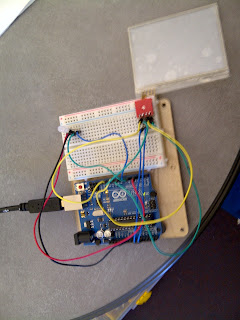


project 35


Sunday, October 28, 2012


Thursday, October 25, 2012
pressure sensor and glcd
barometric pressure sensor tutorial:


project 31:


Glcd library - Rockets


project 32:


Glcd library - Rockets

Tuesday, October 23, 2012
liquid crystal library, thermistor, and fritzing circuit diagram
liquid crystal library part 1
liquid crystal library part 2
liquid crystal library part 3

thermistor

Fritzing circuit diagram from mid-term project
(used a mystery part on the breadboard to represent the camera (2 ouput wires))
Subscribe to:
Posts (Atom)